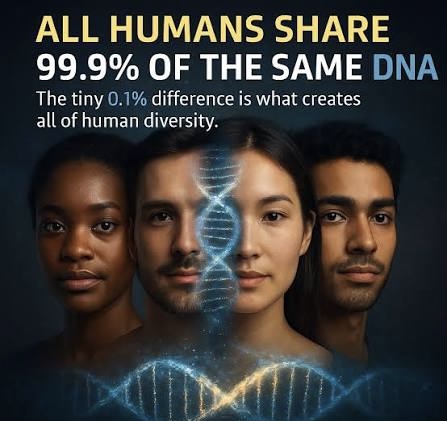
Despite the incredible variety in appearance, behavior, and physiology among people, humans share roughly 99.9% of their DNA. This means that genetically, every person on Earth is far more alike than different.
The remaining 0.1% of our DNA, which accounts for a few million genetic “letters,” is responsible for the wide range of traits that make us unique. These tiny differences shape our skin color, facial features, height, body type, and even how we metabolize food or respond to medications and disease.
Interestingly, most genetic differences do not directly change proteins. Instead, they often influence when, where, and how strongly specific genes are activated during development. Even small shifts in timing or gene regulation can have large, visible effects on physical traits, metabolism, or susceptibility to certain conditions.
This is one of the reasons scientists emphasize that race is not a biological concept. Genetic studies consistently show that variation within a population is often greater than variation between populations. In other words, two individuals from the same “race” can be more genetically different than two individuals from different groups.
At a deeper level, humanity shares a common evolutionary history. Our DNA reveals that we are all part of a closely related global family, with shared origins stretching back tens of thousands of years. These shared genetic roots highlight our fundamental connections as a species.
In short:
🧠 Same blueprint — the vast majority of our DNA is identical.
🧬 Tiny edits — a small fraction of differences create the diversity we see.
🌍 Infinite human diversity — countless combinations of genes result in the unique individuals that populate the planet.
Understanding this shared genetic foundation helps combat misconceptions about race and emphasizes the unity and diversity of humanity. It’s a powerful reminder that beneath the surface, we are all more alike than we are different.