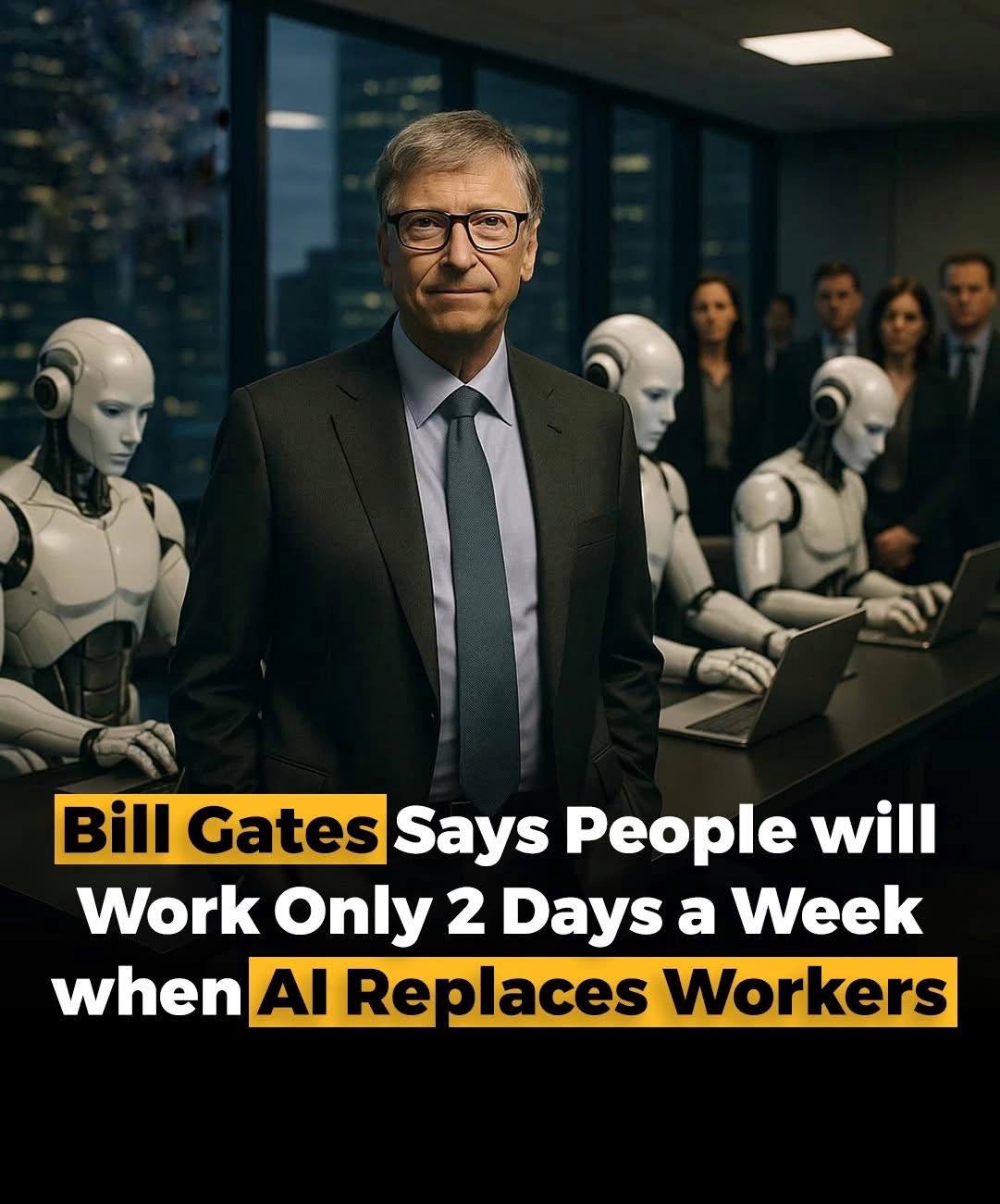
Bill Gates has predicted that the traditional five-day workweek may dramatically shrink to as little as two days within the next ten years, driven by rapid advances in artificial intelligence. According to Gates, AI is evolving at a pace that will allow it to take over a large share of tasks currently performed by humans, fundamentally reshaping the global workforce.
Gates argues that artificial intelligence will increasingly handle knowledge-based work, manufacturing processes, and service-related roles. From data analysis and administrative tasks to logistics, diagnostics, and customer support, AI systems are becoming capable of operating faster, more accurately, and at a much lower cost than human labor. As a result, society could maintain — or even increase — productivity while requiring far fewer working hours from people.
This shift, Gates believes, could free individuals to focus on areas where human involvement still matters most, such as creativity, critical thinking, emotional intelligence, caregiving, and lifelong learning. Rather than defining success through long working hours, people may have more time to pursue personal development, family life, and community engagement.
Although the idea of a two-day workweek once sounded unrealistic, Gates suggests that the accelerating pace of AI development is making this scenario increasingly plausible. He points out that similar fears and skepticism existed during previous technological revolutions, such as the rise of automation and computers, yet those changes ultimately transformed work in ways that were hard to imagine beforehand.
Gates also noted that sectors like healthcare and education are likely to experience some of the most significant efficiency gains. In healthcare, AI could assist with diagnostics, patient monitoring, and administrative workflows, reducing the burden on medical professionals. In education, intelligent systems could personalize learning, automate assessments, and support teachers, allowing them to focus more on mentorship and student engagement.
However, Gates acknowledges that such a transformation would require careful planning. Governments, businesses, and institutions would need to rethink labor policies, income distribution, and education systems to ensure that the benefits of AI-driven productivity are shared broadly. Without thoughtful adaptation, the transition could widen inequality rather than reduce it.
Ultimately, Gates believes that artificial intelligence will force society to redefine the role of work itself. Instead of centering life around full-time employment, the future may prioritize balance, flexibility, and meaningful contribution — with technology enabling people to work less while living better.