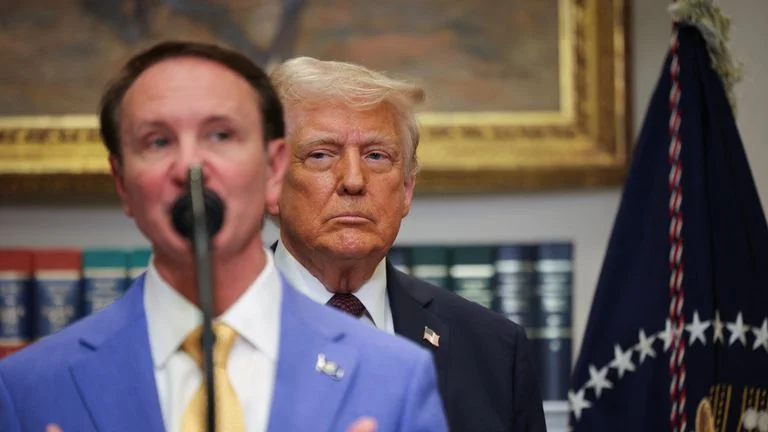
President Donald Trump has announced the appointment of Louisiana Governor Jeff Landry as the new U.S. special envoy to Greenland, a move that has reignited international debate over the strategic future of the vast Arctic island and America’s ambitions in the region.
The announcement was made Sunday, with Trump emphasizing Greenland’s growing importance to U.S. national security and global stability. In a statement, the president said Landry “understands how essential Greenland is to our National Security” and would work to advance U.S. interests “for the safety, security, and survival of our allies — and the world.”
Renewed focus on Greenland
Greenland, a semi-autonomous territory within the Kingdom of Denmark, has long been at the center of Trump’s geopolitical thinking. During his first term and again following his return to the White House, Trump has repeatedly argued that the United States needs greater control or influence over the island due to its strategic location and vast reserves of critical minerals.
The Arctic territory sits at a key crossroads between North America and Europe and is increasingly important as melting ice opens new shipping routes and access to untapped natural resources. The U.S. already maintains a military presence on Greenland through a remote base, which officials say plays a vital role in missile defense and early warning systems.
Trump has gone so far as to say he would not rule out military force to secure control of the island — a statement that has alarmed both allies and rivals, particularly because Denmark is a NATO member.
A controversial appointment
Governor Jeff Landry, who took office in Louisiana in January 2024 and is serving a term that runs through 2028, responded enthusiastically to the appointment. In a post on social media, Landry called it an honor to serve in what he described as a volunteer role and made clear that the envoy position would not interfere with his duties as governor.
“This in no way affects my position as Governor of Louisiana,” Landry wrote, while thanking Trump for the trust placed in him.
Landry’s selection surprised some observers, as he has limited foreign policy experience. However, the White House appears to view the role as both diplomatic and symbolic — signaling renewed American assertiveness in the Arctic.
Diplomatic fallout with Denmark and Europe
Denmark and Greenland have repeatedly stated that the island is not for sale and have rejected any suggestion of U.S. takeover. Danish officials have also criticized reports that individuals linked to Trump conducted covert influence efforts in Greenland earlier this year, prompting Copenhagen to summon the U.S. ambassador for explanations.
The appointment of a special envoy is likely to add strain to already tense relations. The Danish Defense Intelligence Service recently warned that Washington is increasingly using its economic and military power to pressure both allies and adversaries, a trend it says has accelerated under the Trump administration.
According to the agency’s annual assessment, U.S. assertiveness comes at a time when Russia and China are also expanding their presence and influence in the Arctic, raising concerns about long-term stability in the region.
Strategic rivalry in the Arctic
Vice President JD Vance visited Greenland earlier this year, criticizing Denmark for what he described as underinvestment in the island’s security. His remarks, combined with Trump’s rhetoric, have fueled fears that the Arctic could become a flashpoint in great-power competition.
Russia and several European nations have openly opposed U.S. efforts to increase control over Greenland, warning that such moves could destabilize NATO unity and escalate geopolitical tensions.
Analysts note that the Arctic’s importance is only expected to grow, as climate change accelerates access to shipping lanes, energy resources, and rare minerals vital to modern technologies.
What comes next
While the precise scope of Landry’s responsibilities as special envoy remains unclear, his appointment signals that Greenland is once again high on Trump’s foreign policy agenda. Whether the role leads to increased cooperation, diplomatic confrontation, or further controversy remains to be seen.
For now, the move underscores a broader shift in U.S. strategy — one that places the Arctic at the center of global security calculations, even as it risks straining relations with close allies.