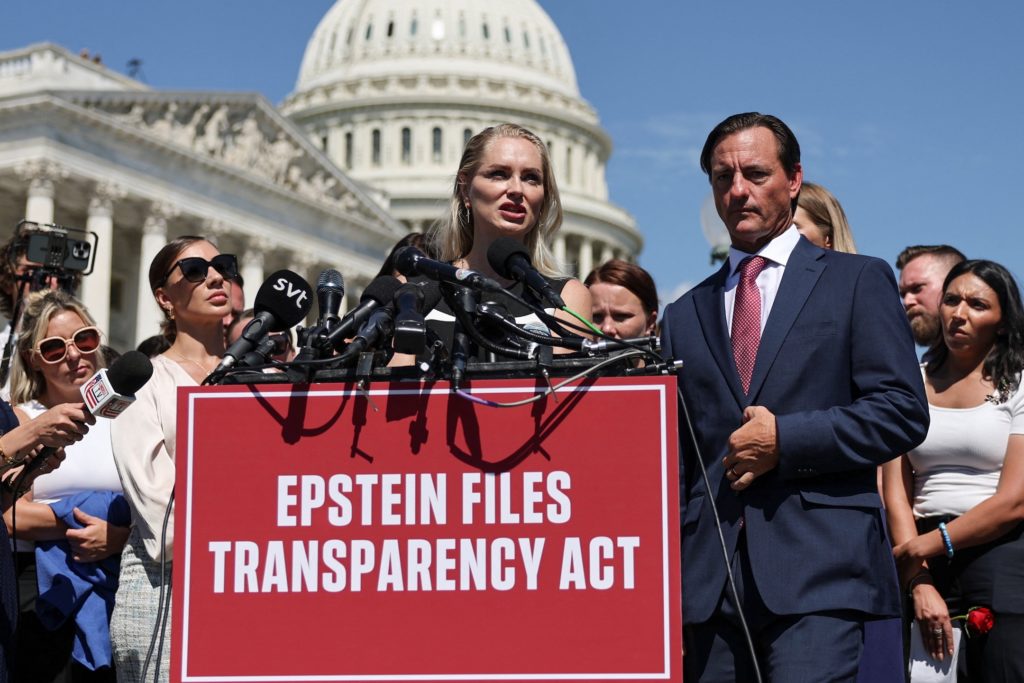
Anouska De Georgiou speaks during a press conference to discuss the Epstein Files Transparency bill, directing the release of the remaining files related to the investigations into Jeffrey Epstein and Ghislaine Maxwell, on Capitol Hill in Washington, D.C., U.S., September 3, 2025. REUTERS/Jonathan Ernst
A rare bipartisan alliance of lawmakers is sharply criticizing the Justice Department’s latest release of files connected to Jeffrey Epstein, calling the heavily redacted documents an insult to survivors and a failure of transparency that undermines public trust.
Democratic Rep. Ro Khanna of California and Republican Rep. Thomas Massie of Kentucky appeared together on CBS’ Face the Nation over the weekend, where they voiced strong frustration over how the Department of Justice handled the long-awaited disclosure. Both lawmakers described the document dump as deeply disappointing and accused Attorney General Pam Bondi of disregarding both the intent and the requirements of the law.
Khanna did not mince words, calling the release a “slap in the face of survivors” and suggesting that the extensive redactions resemble a deliberate cover-up rather than a good-faith effort to protect victims.
“The problem here is that there are rich and powerful people who either engaged in this abuse, covered it up, or were on that island,” Khanna said. “The American people want accountability. Instead, what they’re seeing is secrecy, obstruction, and a Justice Department that appears unwilling to tell the full truth.”
A law meant to force transparency
Khanna and Massie were the leading architects of last month’s bipartisan Epstein Files Transparency Act, which passed with broad support in Congress. The legislation required the DOJ to release records related to its investigations into Epstein within 30 days, a move lawmakers hoped would finally bring clarity to years of unanswered questions surrounding the disgraced financier’s network and enablers.
While the Justice Department has now released more than 13,000 files, lawmakers and the public alike have reacted with outrage to the sheer number of pages that are almost entirely blacked out. In addition, several documents that initially appeared in Friday’s release were later removed, further fueling suspicion and anger.
Massie argued that the DOJ is violating not only the spirit of the law, but its explicit requirements.
“They’re flouting the letter of the law,” he said. “This is not transparency. This is obstruction dressed up as compliance. And I won’t be satisfied until the survivors themselves are satisfied.”
Contempt charges on the table
Massie went a step further by suggesting that Attorney General Bondi could be held in contempt of Congress if the DOJ continues to resist meaningful disclosure. He described contempt proceedings as the “quickest” and “most expeditious” path to justice for Epstein’s victims, signaling that congressional patience is wearing thin.
The Kentucky Republican, who has repeatedly clashed with the Trump administration over its handling of the Epstein case, emphasized that accountability should not be partisan.
“This isn’t about left versus right,” Massie said. “It’s about whether the most powerful people in this country are subject to the same laws as everyone else.”
DOJ defends its actions
The Justice Department has pushed back against the criticism. Deputy Attorney General Todd Blanche defended the extensive redactions in a statement released on social media Saturday, arguing that they are necessary to protect victims’ identities and prevent further harm.
Blanche said the department is exercising an “abundance of caution” as it continues to review and prepare additional materials for release. However, critics argue that the scope of the redactions goes far beyond what is required to protect survivors and instead shields influential figures from scrutiny.
Growing pressure for answers
For survivors and advocates, the controversy has reopened old wounds and reinforced fears that justice is still being delayed or denied. Lawmakers from both parties say the current approach risks eroding confidence in the Justice Department and sends the wrong message to victims of abuse.
As pressure mounts, Khanna and Massie have made clear they are not backing down. Both lawmakers insist that transparency is essential—not only to honor survivors, but to ensure that no one, regardless of wealth or power, is above the law.
Whether the DOJ will revise its approach or face escalating congressional action remains an open question, but one thing is clear: bipartisan anger over the Epstein files is growing, and the demand for full accountability is far from over.