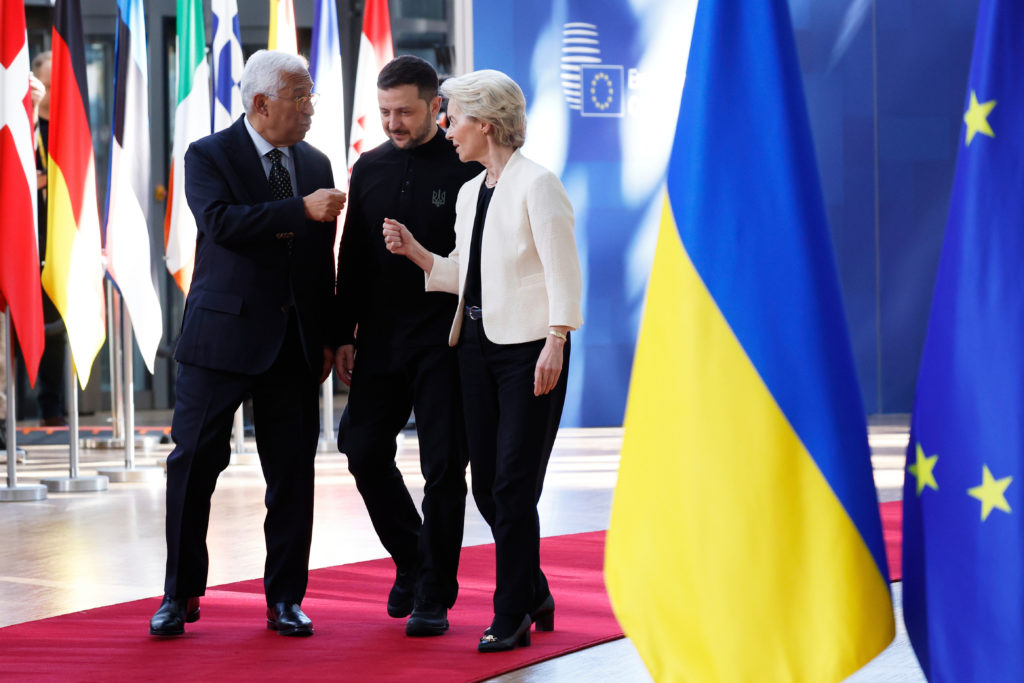
FILE - From left, European Council President Antonio Costa, Ukraine's President Volodymyr Zelenskyy and European Commission President Ursula von der Leyen arrive for an EU Summit at the European Council building in Brussels, March 6, 2025. (AP Photo/Omar Havana, File)
Europe is approaching a critical crossroads as leaders debate whether frozen Russian state assets should be used to provide additional support to Ukraine. The proposal, which would be unprecedented in scope, has exposed divisions within the European Union at a time of mounting geopolitical pressure and growing uncertainty over long-term funding for Kyiv.
EU leaders are expected to address the issue at a high-level summit later this week. While many member states favor the plan as a way to sustain assistance for Ukraine, Belgium has emerged as a key voice of caution. The country holds most of the frozen assets through its financial infrastructure and has raised legal, financial, and security concerns about moving forward.
The discussion comes amid increasing strain on European unity, heightened threats from Russia, and questions about how long public support for Ukraine can be maintained without new funding mechanisms.
What Is Being Proposed?
Following Russia’s full-scale invasion of Ukraine in 2022, the European Union froze Russian central bank assets held within its jurisdiction as part of sweeping sanctions. Until now, the EU has relied on income generated from those assets to contribute to its assistance for Ukraine.
The new proposal would go further. Instead of using only interest or returns, the EU would rely on the frozen assets themselves as the basis for a loan to Ukraine. The idea is that Ukraine would repay the loan if and when Russia is required to pay reparations for the damage caused by the war.
European Commission officials argue that because sanctions prevent Russia from accessing the assets, the resulting funds are no longer under Moscow’s control. As bonds mature and convert into cash, the EU considers these balances available for use under existing restrictions.
European Commission President Ursula von der Leyen has framed the proposal as a temporary solution designed to ensure continuity of support while preserving the principle that Russia remains financially responsible for the war.
Approval would require backing from a qualified majority of EU member states, rather than unanimous consent, making the proposal easier to pass than other funding options currently under consideration.
Why Is the Plan Controversial?
Despite broad political support, the proposal has sparked intense debate. Critics warn that using frozen sovereign assets in this way could set a dangerous legal precedent and provoke retaliation from Russia.
Belgium, where most of the assets are held through the financial services firm Euroclear, has been particularly outspoken. Belgian officials argue that the plan exposes their country to legal challenges and financial risks that may not be fully covered by EU guarantees.
The Belgian government has emphasized that such a move has never been attempted before and could lead to lawsuits, diplomatic fallout, or countermeasures targeting European assets abroad. Concerns also extend to the possibility that Russia could seize foreign-owned assets in retaliation.
Legal experts have pointed out that while the EU may protect member states against loan repayment risks, it is unclear whether broader legal and administrative costs would be covered. This uncertainty has made some governments hesitant to proceed.
Other EU countries, including Italy and the Czech Republic, have also expressed reservations, citing domestic financial pressures and the need to prioritize national spending.
Broader Economic and Strategic Concerns
Beyond immediate legal risks, some policymakers worry about the long-term implications for Europe’s financial credibility. There is concern that using frozen assets in this manner could make foreign governments more cautious about holding reserves in Europe, especially countries that may fear future sanctions.
China is often cited in this context, as observers suggest that such a precedent could influence how non-European states assess the safety of storing assets within the EU.
At the same time, Russia has made clear that it views any transfer of its frozen assets as illegal. The Kremlin has warned that consequences would follow and has already initiated legal action against Euroclear, framing it as a defensive move against potential asset transfers.
The United States and the Global Dimension
The debate is also unfolding against the backdrop of differing approaches between Europe and the United States. Washington has shown interest in using frozen Russian assets as part of broader reconstruction efforts in Ukraine, potentially under US leadership.
However, since the majority of the assets are held in Europe, the EU retains decisive influence over how they are used. European officials stress that no final decision can be made without EU involvement, regardless of external proposals.
Meanwhile, US financial support for Ukraine has declined in recent months, increasing pressure on Europe to fill the gap. European nations have already taken on a larger share of aid commitments, reinforcing arguments that new funding solutions are urgently needed.
Ukraine’s Perspective
For Ukraine, the stakes are extremely high. Ukrainian leaders have warned that without sustained and predictable support, the country will struggle to maintain economic stability and essential services while continuing to defend itself.
President Volodymyr Zelensky has argued that frozen Russian assets represent one of the few viable options for offsetting reductions in international aid. Without them, he has said, Ukraine risks facing deep economic shortfalls with no clear alternatives.
A Decision With Lasting Consequences
The EU has pledged to continue supporting Ukraine regardless of the outcome of this proposal. However, failure to agree on the use of frozen assets would force European governments to search for other funding sources at a time of increasing political fatigue and fiscal pressure.
The decision now facing Europe goes far beyond short-term financing. It touches on international law, financial stability, collective security, and the future role of the EU on the global stage.
As leaders gather for the summit, the outcome will signal not only how far Europe is willing to go to support Ukraine, but also how it balances unity, risk, and responsibility in a rapidly changing world.