The year-over-year inflation rate in the U.S. in January, the month President Donald Trump returned to the White House, was 3.0%. Eight months later, in September—the most recent month for which Consumer Price Index (CPI) data is available—inflation remained exactly the same: 3.0%.
This fact contradicts Trump’s triumphant claims that “inflation has stopped” after he “inherited the worst inflation in our country’s history.” Faced with these real numbers, the administration has opted for a different strategy: using selective and misleading comparisons.
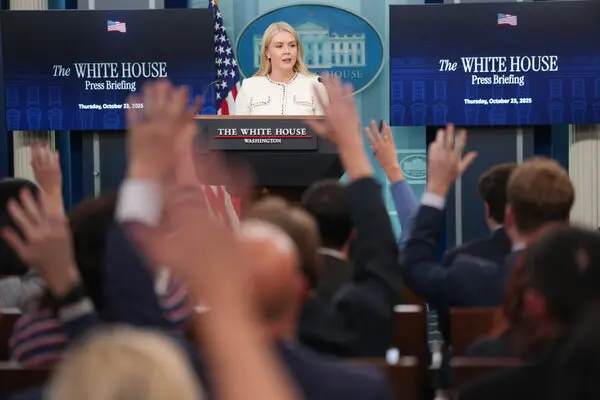
White House Press Secretary Karoline Leavitt exemplified this approach during a press briefing.
Misleading Monthly vs. Average Comparisons
When asked about inflation remaining nearly the same as last year and rising grocery prices, Leavitt stated that inflation “has gone down” and is “averaging 2.5%,” compared to the “2.9%” Trump supposedly inherited.
But these claims don’t match the latest data. In fact, year-over-year inflation increased for five consecutive months—from 2.3% in April to 3.0% in September. So, there is no downward trend; if anything, inflation accelerated in recent months.
The 2.5% figure Leavitt cited is an eight-month average from February through September, not the inflation rate for a single month like January. This is not an apples-to-apples comparison. Additionally, including the first three months of Trump’s term—before his global tariffs in April—lowers the average and understates the recent inflationary pressure. Inflation began rising significantly in May.
Even more, the simple arithmetic average of these eight months is 2.7%, not 2.5%. The White House later clarified that the 2.5% was an “annualized” figure, but that distinction was not made clear during the briefing.
Comparing a Peak to an Average
Another example is a White House social media graphic that said: “9.1% Inflation under Biden” and “2.7% Inflation under Trump.”
Only in small print did it note that these figures were not directly comparable. The 9.1% figure represented a one-month peak during Biden’s presidency (June 2022), while 2.7% was the eight-month average for Trump through September 2025. The graphic did not mention that inflation had dropped to 3.0% by June 2023, 2.4% by September 2024, and 3.0% in Biden’s final partial month in office.
Leavitt used the same logic at the briefing, emphasizing that inflation had reached “a record 9%” under “painful Biden years” while under Trump it had “dropped to an average of just 2.7%.” Technically correct, the way these numbers were presented created a misleading impression.
Conclusion
The issue isn’t just the numbers themselves, but how they are used. Comparing peaks to averages, or single months to multi-month averages, crafts a narrative that does not reflect the economic reality Americans face.
While inflation may be lower than prior peaks, it remains unchanged from the start of Trump’s term and continues to affect the cost of living. For many Americans, carefully chosen statistics do not match their everyday experience.